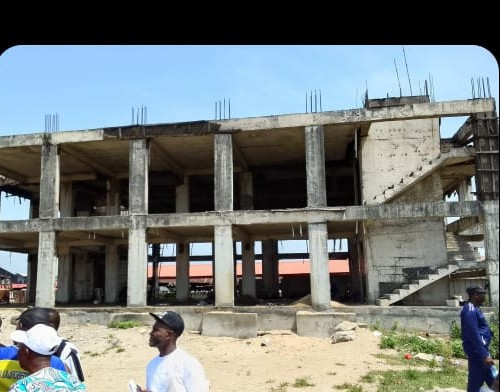
In public leadership, some projects decorate speeches, and there are those that define commitment. The difference is simple: one exists in words, the other in concrete. In Ajeromi-Ifelodun, the story of the uncompleted five-storey Youth Centre stands as a powerful reminder of both.
Conceived and attracted by Hon. Kolawole Musbau Taiwo during his tenure as a member representing Ajeromi-Ifelodun Federal Constituency in the House of Representatives, the Youth and Human Development Centre was never meant to be just another structure. It was envisioned as a transformative hub, a space for skills acquisition, youth empowerment, innovation, and community development. A bold intervention for a constituency brimming with talent but in need of opportunity…Ajeromi Ifelodun federal constituency, we no go miss this opportunity.
Today, the structure still rises, five storeys high; silent, unfinished, but far from forgotten.
It tells two stories at once.
First, it speaks to vision. It reflects a leadership that did not just think about the present but invested in the future of young people. The scale of the project alone underscores the seriousness of purpose; it was not a token initiative, but a legacy-defining commitment.
Second, it speaks to interruption. Since the end of Taiwo’s brief tenure, the project has remained stalled. The promise of completion, of turning concrete into opportunity, has not materialized under subsequent representation. What should have become a vibrant center of youth development now stands as a monument to halted progress. Some people want to cover the dreams and vision of Mr Ajegunle, the one who has the good of the constituency at heart, because they forgot no hand covers the moon.
And this is where the Yoruba expression becomes even more profound: “ó máa lù lé.”
Impact does not disappear. It lingers. It confronts. It reminds…Hon Kolawole Taiwo must go back to complete this project and numerous other uncompleted projects by his incompetent predecessor.
Every passerby who sees that towering structure is confronted with a simple question: what could have been and what still can be?
For many in Ajeromi-Ifelodun, the answer is becoming clearer. The renewed calls for the return of Hon. Kolawole Musbau Taiwo are not driven by nostalgia, but by evidence. The Youth Centre is not just an abandoned project; it is a visible, verifiable proof of capacity, intent, and unfinished business.
Because leadership is not only about starting strong, it is about finishing what matters.
The uncompleted five-storey Youth Centre is more than concrete and steel; it is a metaphor. A constituency paused mid-progress. A vision awaiting completion. A future delayed, but not denied.
If indeed ó máa lù lé, then this impact is still speaking loudly. And its message is unmistakable:
Return to finish the work. Complete the promise. Let the vision live.