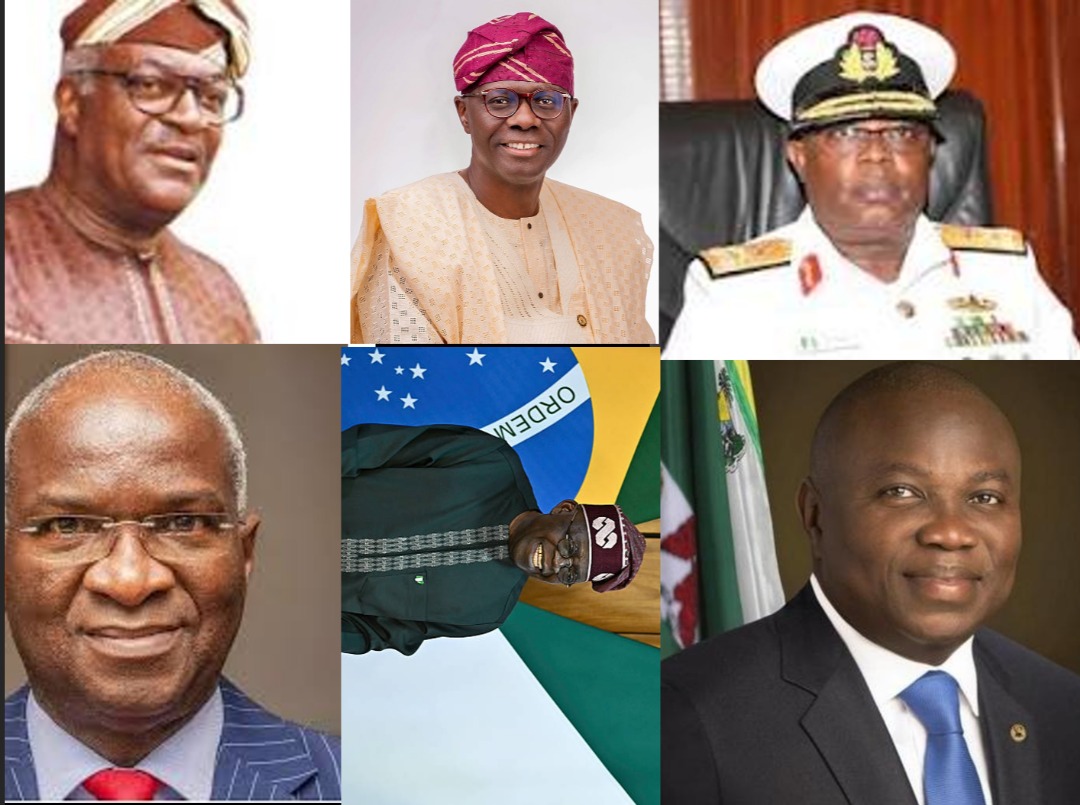
For nearly six decades, the story of Lagos State has been told through the faces of its governors — soldiers and civilians alike who have steered its course from a small coastal territory to a megacity admired across Africa. Yet, despite this long history of leadership rotation among divisions, Badagry Division remains the only one never to have produced a governor.
Since the creation of Lagos State in 1967, the baton of leadership has passed through the hands of illustrious sons of other divisions.
The journey began with Brigadier Mobolaji Johnson, Lagos State’s pioneer Military Governor (1967–1975), a proud son of the Lagos Division.
He was succeeded by Commodore Adekunle Lawal (1975–1977), also from the Lagos Division, and later by Commodore Ndubuisi Kanu (1977–1978), who hailed from Abia but governed Lagos during the military era.
Commodore Ebitu Ukiwe (1978–1979), of similar background, also served briefly before the return to civilian rule.
The Second Republic brought the legendary Alhaji Lateef Jakande (1979–1983), again from the Lagos Division, whose monumental reforms laid the foundation of modern Lagos.
Subsequent military administrators continued in similar regional patterns — Commodore Gbolahan Mudasiru (Ikeja Division), Group Captain Ndubuisi Kanu, and Brigadier Raji Rasaki (Lagos Division) , before the dawn of the Fourth Republic.
When democracy returned in 1999, Asiwaju Bola Ahmed Tinubu, from the Ikeja Division, became governor, followed by Mr. Babatunde Raji Fashola (SAN) from the Lagos Division.
In 2015, Mr. Akinwunmi Ambode, a son of the Epe Division, succeeded him, marking the first time Epe produced a governor.
The current administration of Governor Babajide Olusola Sanwo-Olu, also from the Lagos Division, further extends that pattern.
From 1967 till date, spanning over 58 years Lagos State has seen leadership from Lagos, Ikeja, and Epe Divisions, while Ikorodu has been significantly represented at the deputy level.
But one region, Badagry Division, the historic cradle of civilization, Christianity, and education in Lagos has never been given the opportunity to lead.
This is more than a statistical oversight. It is a question of equity, inclusion, and historical justice.
Badagry is not a political outsider; it is an integral pillar of the Lagos story, the land through which the state’s first contact with Western civilization began. It is the gateway to West Africa, a strategic border zone rich in tourism, trade, and cultural heritage.
Its sons and daughters have contributed enormously to Lagos’ development in public service, academia, the civil service, and political structure yet have never been entrusted with the mantle of governorship.
If Lagos truly prides itself as a model of fairness and inclusiveness, then 2027 must mark a new chapter, one that corrects this long-standing imbalance. The call for a governor from Badagry Division is not born of entitlement but of justice and proportional representation.
No division should remain perpetually on the sidelines of leadership in a state that calls itself Centre of Excellence.
As Lagos continues to evolve into a 21st-century smart city, unity and fairness must remain at the heart of its progress.
The next transition of power offers a golden opportunity , not just to make history, but to heal history.
Let Lagos complete the circle of leadership.
Let justice roll down to the ancient shores of Badagry.
Let the next governor of Lagos State emerge from Badagry Division , the division whose time has truly come.