

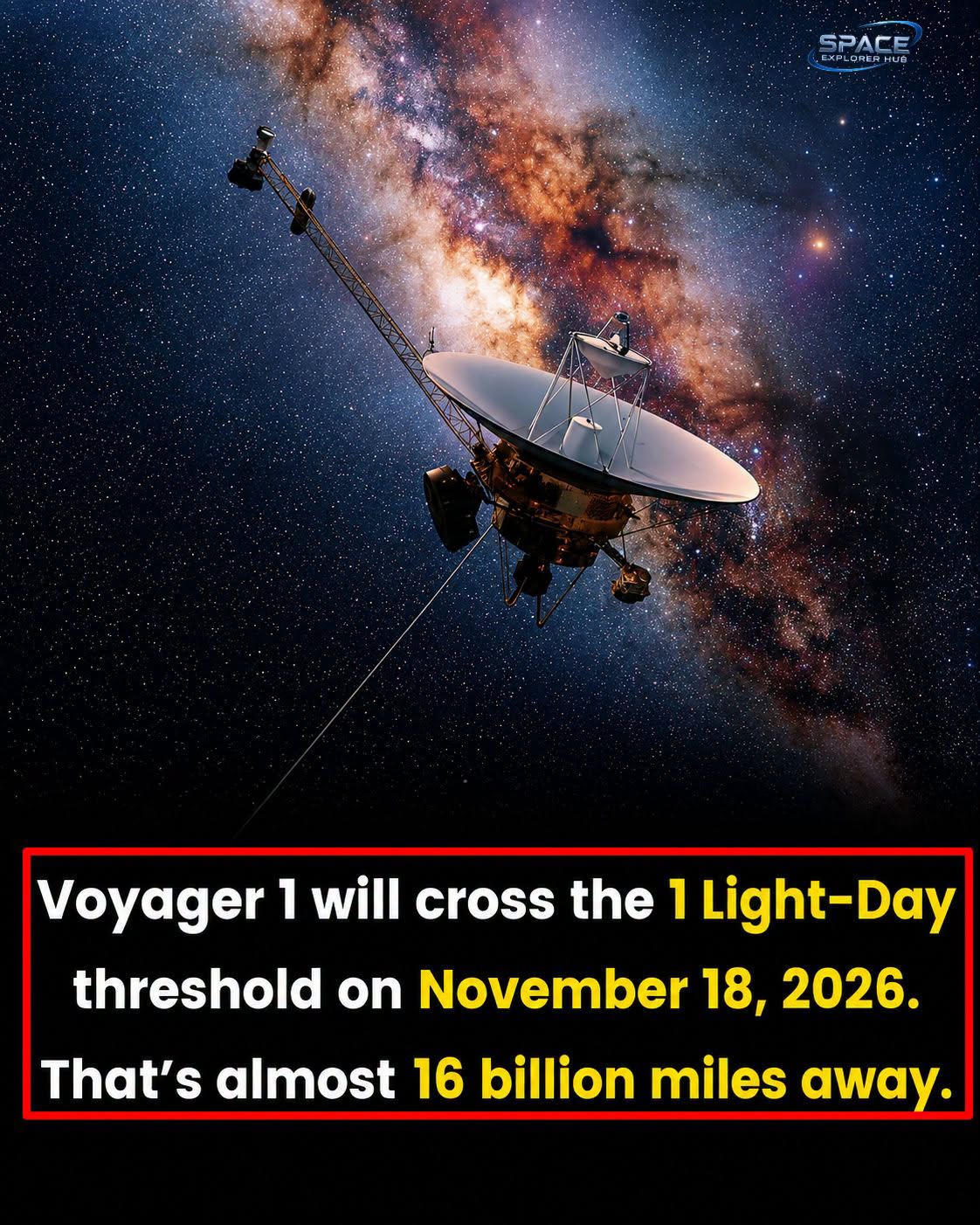
The relentless efforts of humanity to explore the unknown are yielding extraordinary results, with a spacecraft launched nearly five decades ago now approaching a milestone that could redefine how we understand the enormous scale of interstellar space.
NASA’s Voyager 1, launched in 1977, is expected to become the first human-made object to reach a distance of one light-day from Earth on November 18, 2026, a staggering 16.1 billion miles (25.9 billion kilometres) from its home planet.
The milestone is more than a measure of distance. It represents almost half a century of human curiosity, scientific ingenuity and persistence in pushing beyond the boundaries of what was once considered reachable.
A light-day is the distance light travels in 24 hours. At that point, any radio command sent from Earth to Voyager 1 will take approximately 24 hours to reach the spacecraft, while a response would require another 24 hours to return.
For the first time, humanity will have a spacecraft so far away that even travelling at the speed of light, communication between Earth and its creation will take about two days for a round trip.
Voyager 1 began its extraordinary journey on September 5, 1977, initially tasked with exploring the outer planets. It flew past Jupiter in 1979 and Saturn in 1980 before continuing into the outer reaches of the solar system.
In 2012, it achieved another historic feat when NASA confirmed that it had crossed the heliopause and entered interstellar space, becoming the first spacecraft to do so.
Nearly 49 years after its launch, Voyager 1 continues to transmit information from the distant frontier, even as its dwindling power forces NASA engineers to gradually shut down instruments in order to keep the ageing spacecraft operating.
Its journey offers a striking lesson about the scale of the cosmos.
What appears to humanity as an enormous distance more than 16 billion miles remains only a tiny step when measured against the distances between stars.
Yet Voyager 1 continues to move outward, carrying with it a remarkable message about human ambition: that curiosity can send us places we have never physically reached before.
From Earth, Voyager 1 may simply appear as a tiny spacecraft disappearing into the darkness.
But its journey represents something much bigger , humanity refusing to stop at the edge of the known.
And in November, after nearly half a century in flight, that journey will cross yet another extraordinary threshold.